
How Assistive Wearables Support Everyday Life for Older Adults
Wearable technology — devices worn on the body throughout the day — has become genuinely practical for older adults in ways it wasn’t just a few years ago. The most useful wearables now in wide use address three real daily concerns for older adults living independently: fall safety, health monitoring, and hearing assistance. This guide covers what’s available in each category, what it actually does, and what to consider when deciding whether it’s worth adding to your daily life.
Smartwatches With Fall Detection: The Apple Watch
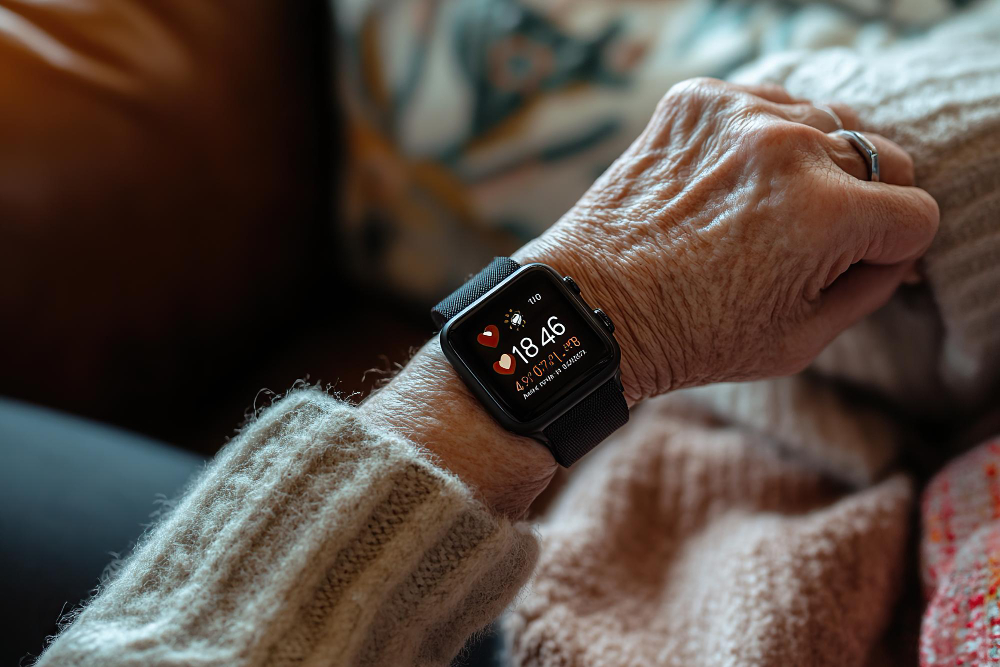
The Apple Watch (Series 4 and later) is the most widely used wearable among older adults, and its fall detection feature is the most compelling reason. When the watch detects a hard fall — through its built-in accelerometer and gyroscope — it displays an alert asking if you need help. If you don’t respond within about 60 seconds, it automatically calls emergency services and sends your GPS location to your designated emergency contacts. This happens without any action required on your part.
Fall detection has documented its value in real cases. The CDC reports that falls are the leading cause of injury-related deaths among adults 65 and older, and that many serious falls are made significantly worse by delayed response — someone unable to reach their phone lying on the floor for hours. The Apple Watch addresses this specific scenario: it gets help even when you can’t.
Beyond fall detection, the Apple Watch monitors heart rate continuously throughout the day and can alert you to unusually high or low readings. It includes an ECG function (available in the Health app) that can detect irregular heart rhythms associated with atrial fibrillation — a common heart condition in older adults that often has no obvious symptoms. The watch also tracks blood oxygen levels and sleep patterns.
The Apple Watch requires an iPhone to set up and sync, costs between $200 and $400 depending on the model, and needs to be charged daily (most people charge it overnight). It works best worn continuously throughout the day, including during walks and household activities — which is when fall risk is highest.
Dedicated Medical Alert Wearables
For older adults who don’t want a full smartwatch, or whose primary concern is emergency response rather than health monitoring, dedicated medical alert systems offer a simpler alternative. These are wearable buttons — typically worn around the neck or on the wrist — that connect to emergency services or a monitoring center when pressed.
The key advantage over smartphone-based solutions is reliability: the button works even if your phone is in another room, has a dead battery, or is otherwise unreachable. Dedicated medical alert devices typically have multi-day battery life and are designed to be worn continuously, including in the shower.
Medical Guardian, Bay Alarm Medical, and Life Alert are the most established services in this category. Monthly fees typically range from $20 to $45. Most services now offer GPS-enabled devices that work outside the home as well as inside, providing coverage during walks and errands. Some newer devices also include automatic fall detection — similar to the Apple Watch — without requiring the user to press a button.
When evaluating a medical alert service, the most important factors are response time (how quickly an operator answers after the button is pressed), whether the device works outside the home, and whether fall detection is included. Most services offer a free trial period, which is worth using before committing to a subscription.
Modern Hearing Aids and Bluetooth Connectivity
Hearing aids have changed significantly in the past several years, and the most meaningful improvement for older adults is Bluetooth connectivity. Modern hearing aids from major manufacturers — Phonak, Oticon, Widex, Starkey, and ReSound — can now stream audio directly from an iPhone or Android phone to the hearing aids, bypassing the room’s ambient sound entirely.
In practical terms, this means phone calls play directly in your hearing aids at the volume and frequency profile programmed for your specific hearing loss — dramatically clearer than holding a phone to your ear and relying on room acoustics. TV audio and music can stream directly to the hearing aids as well. Many models also include rechargeable batteries, eliminating the finicky task of replacing small batteries every few days.
Hearing aids are prescribed and programmed by audiologists based on your specific hearing test results. They are not consumer devices you can purchase and self-configure. If you currently use hearing aids that are more than five years old, it’s worth asking your audiologist whether current models with Bluetooth streaming would be compatible with your phone and worth upgrading to.
Choosing What’s Right for Your Situation
The right wearable depends on which daily concern is most pressing. For fall safety and basic health monitoring, the Apple Watch offers the broadest set of features if you have an iPhone. For emergency response specifically — particularly for someone who lives alone or has a history of falls — a dedicated medical alert service provides a more focused, reliable solution with lower daily complexity. For hearing, the right answer is working with an audiologist to evaluate whether current hearing aid technology would meaningfully improve your specific situation.
None of these decisions need to be made all at once. If fall safety is the primary concern, start there. If hearing in daily conversations and on the phone is the bigger problem, prioritize an audiology evaluation. The goal is to find the one wearable that addresses your most significant daily limitation — and wear it consistently enough for it to actually help.

Dan Alex is the founder and lead writer at Apps for Download, focused on translating digital literacy and accessibility topics into clear, jargon-free guidance for older adults and their families. Every guide is researched against reputable sources on digital safety and assistive technology rather than presented as personal expertise alone.